The Mummified Monk
“How do you die before you die? You become the part of yourself that doesn't die.”
In the mountains of northern Japan, there are monks who believed they could die while still inside the body. Not as a symbol or a concept — literally mummifying themselves while they were still alive. They prepared for years, slowly stripping the body down until there was almost nothing left, and when the time came, they would bury themselves alive. After three years the body is dug up, and if there are no signs of decay, it's enshrined and immortalized as a living Buddha. They call it Sokushinbutsu. Almost everyone who attempted it failed and disappeared into history.
But there is one who didn't. His name is Tetsu Monkai. He was born in 1759 in Yamagata, to a poor family, and in his youth he had a rough life doing manual labor to support them. In his twenties he falls in love with a prostitute, and things turn violent — a fight over her ends with two samurai dead. That is a crime punishable by death, so he runs into the mountains, and he ends up at Churenji Temple. This is where he first meets the Yamabushi. These are not passive monks sitting in temples; they use suffering as the path to awakening. Tetsu Monkai stays, and he starts pushing the practices to their limits — until at some point it stops being about discipline and becomes physical. He began removing parts of himself.

My first pilgrimage point was a small shrine called Nangakuji, tucked into the corner of a modern town — a mummified monk behind glass, right across from someone's house. A little old woman brought me inside and showed me the body of Tetsu Ryokai, a disciple of Tetsu Monkai. He was not successful in his mummification. When you're looking at a guy who mummified himself while he was alive, you have all kinds of thoughts going through your head — mostly just, wow, humanity is pretty crazy. And the fact that me and this lady are just sitting here like everything's normal is also pretty crazy.
And just as I was about to leave, I noticed something preserved next to him that they say belonged to his teacher, Tetsu Monkai. It was his genitals. The story goes that the woman he had killed the two samurai over came looking for him, and she begged him to leave monastic life — please come back and be in love with me. He turns around, walks inside the temple, and after some time he walks back out slowly, holding something wrapped in cloth. He doesn't say a word. He just places it in her hand. He had cut off his genitals and handed them to her. And by the time she made it down the mountain, that sacrifice had woken her up from her illusions of life, and she became enlightened.
Somehow it feels like they were touching something more true than I can even imagine. I don't know if I believe in anything in my life deep enough to sacrifice even the most basic things. That's what I was reflecting on in there: what do I actually believe in?
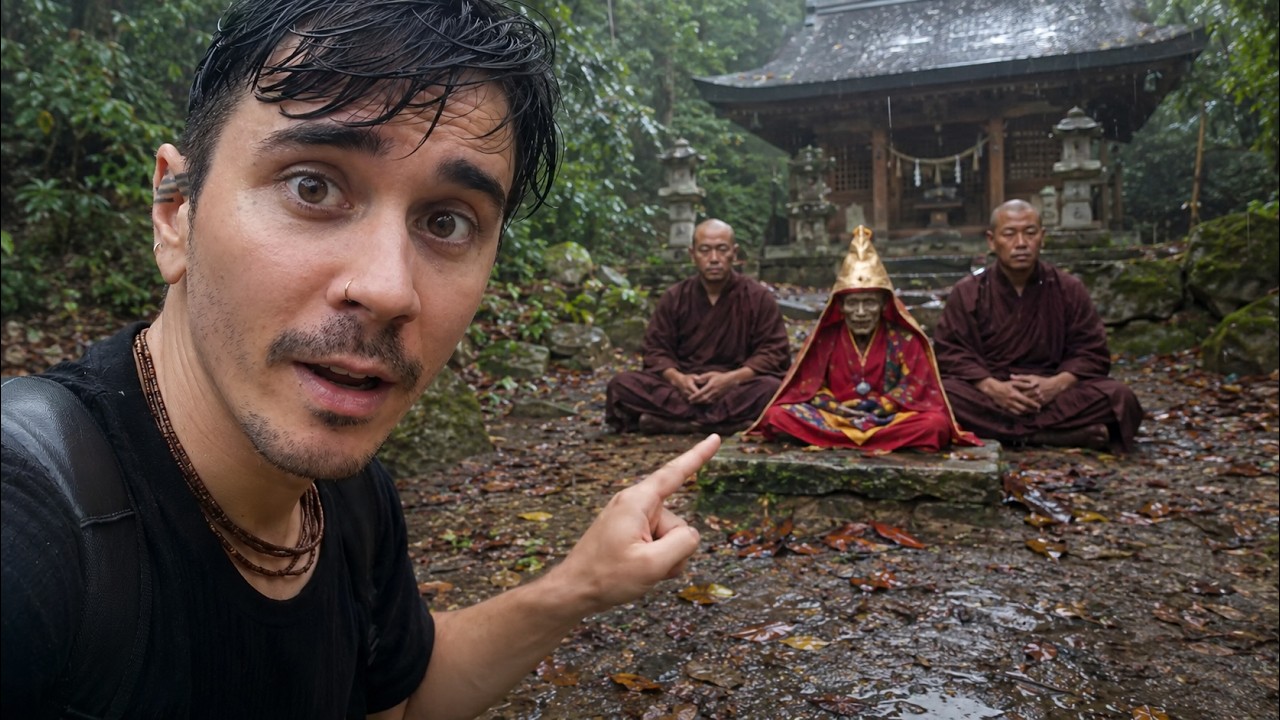
The more I dug, the more I realized it didn't start with Tetsu Monkai, but with a man called Hiokai. He lived during a time when everything was collapsing — a famine — and when he looked around, he saw everyone suffering. He did what he could to help, but there was a moment when he fell to his knees and realized that no matter how hard he tries, no matter how much he gives, it doesn't last. And on his knees, he had a spontaneous awakening — he realized the eternal presence. He decided to make the ultimate sacrifice, believing it would restore balance to his community, and they say that after he finished, everything went back to normal. That's why he is enshrined as a living Buddha — one of the oldest in the area.
If you seek and seek and seek, when you reach the end of that seeking there is a place that is unspeakable. It's eternal. It just is — an isness that always exists. When all of this falls away, when your life falls away, that's the place it falls into. That is what the Buddha spoke about, because it is the beyond, and you are that more than you are whatever you think you are in this moment. These men saw the mystery, and they walked into it completely.
I was left with one question: how do you die before you die?

The trail kept going. Sennin Sawa, the swamp of the magicians, where the monks practiced isolation and ritual starvation that sometimes lasted up to three thousand days. Then Daichibo, a temple where the lineage was never broken — over a thousand years, passed directly from master to disciple. The monk there explained the immortal diet: a thousand days of wild nuts, seeds, roots, and tree bark, until the body is stripped completely of fat and there is nothing left to rot. After that, the final ingredient — the lacquer of the urushi tree, a sap that is poison to the body. It makes you puke, it makes you sweat, and it kills everything inside of you. It spreads through you like a vine, so that all the bacteria die and there's no decomposition afterward. By that point you're hardly conscious, but you're led to your chamber and buried alive with a bamboo shoot for air and a little bell that you ring every day to let them know you're still alive. And one day it stops ringing.
“There is no Tetsu Monkai. The body is a mirror.”
The monk said there was only one true Sokushinbutsu, but he never said who. So afterward I leaned in and asked another Japanese traveler who the monk had meant. He said, "Tetsu Monkai." From the beginning of my journey, it all pointed back to him.
The problem is that Churenji Temple has been closed for years. I decided to go anyway, because if I didn't, my pilgrimage would feel incomplete. I figured I'd just sit at the bottom of the stairs. It took me four days to get there, walking through the mountains; I had packed a pillow and a blanket in case I had to sleep outside. And then the road curves and you see this staircase.

This is where it gets crazy. I get to the top and the door is open. I sneak up real slow, and every step creaks because the wood is over a thousand years old, and I peek inside — and there is the monk who takes care of the temple, giving a tour to a politician. He acknowledges me, and I just sit down. I have no idea why he let me in. Every step of the way, everyone had said no, the temple's closed. The internet said closed. The information center said closed. But there I was.
I sat at the feet of Tetsu Monkai, whose body is still in the lotus position, still clutching his beads, and meditated. I can't explain the feeling of being in the presence of someone who lived a life of true self-sacrifice, who really was touching transcendence. There's a stillness that comes off it. You have no thoughts. It just washes over you. And the whole time, he kept turning away everyone else who came to the door — but not me. I asked him, through a translator, why he let me in and turned everyone else away, because it seemed too magical. He just laughed and said, "Timing."

At the beginning, the question felt impossible: how do you die before you die? But sitting there, looking up at him, I think I finally got the answer. What made him so powerful is that he didn't identify with Tetsu Monkai. He didn't identify with the body. He identified with the part of himself that is eternal. So how do you die before you die? You become the part of yourself that doesn't die. And when I looked at him, I saw it clearly — there is no Tetsu Monkai. That's the teaching. This is not the thing. The body is a mirror. I don't think you can really understand Sokushinbutsu — how could you understand such a thing? But that's what I saw.
